
It’s Only the End of the World [2016] – ★★★★
This is my second post for the amazing O Canada! Blogathon hosted by Ruth of Silver Screenings and Kristina of Speakeasy (check out some of the amazing entries here).
“There I was…after twelve years of absence, and in spite of my fear, I was going to visit them. In life, there are a number of motivations…that force you to leave, without looking back. And there are just as many motivations that force you to return. So, after all those years, I decided to retrace my steps. Take the journey…to announce my death.” Such are the thoughts of young man Louis (Gaspard Ulliel) as he takes a plane to visit his estranged family after twelve years of absence. Louis suffers from a terminal illness, which means that death is at his doorstep. Few directors working today can convey the depth of emotion on screen as masterfully as Xavier Dolan can, and It’s Only the End of the World is yet another film which is a proof of that statement. In this film, Dolan demonstrates that he can exercise some visual restraint, but It’s Only the End of the World still ends up being as potent, emotionally-moving, and convincing as his previous work.
Dolan based his film on a play by Jean-Luc Lagarce titled Juste la Fin du Monde (1990), and that fact alone inevitably means that the film feels theatrical and suffers from all the drawbacks (including the lack of sufficient plot development) possessed by many other movies based on plays (see Polanski’s Carnage (2011) or Almereyda’s Marjorie Prime (2017)). And yet, It’s Only the End of the World never loses its appeal, thanks to numerous factors, including the clever direction, excellent work of the talented cast, and the nostalgic soundtrack.
The openings and endings of Xavier Dolan movies are always things of beauty, and It’s Only the End of the World is no exception. As Louis makes his journey in a taxi to his family home, he passes many suburban homes, undoubtedly reflecting on what his life would have been like if he had never left. The song here is “Home is where it hurts“ by Camille, and it is so evocative that the opening scenes are immediately grabbing. Throughout the film, Dolan never departs from one of his biggest strengths when film-making – the great use of music, and we also hear such effective tracks as “Dragostea dintei“ by O-Zone and “Une Miss d’immisce” by Exotica. And this is not even mentioning the beautiful score composed for this picture by eminent Gabriel Yared (The English Patient (1996), Betty Blue (1986)).
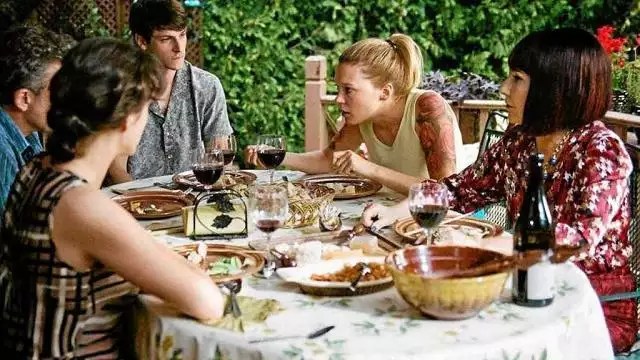
The moment Louis arrives at the doorstep of his family home, he finds himself in an almost foreign to him and chaotic terrain. His family members talk over each other, never really listening to what each of them says, and the situation is further compounded since each of them seems to be a larger-than-life personality. Louis’s mother Martine (Nathalie Baye) is a high-spirited woman that is labelled “nuts” by her daughter Suzanne; Suzanne herself, Louis’s sister (Lea Seydoux), is a trying young woman on a rebellious side, and Antoine (Vincent Cassel), Louis’s older brother, comes off as short-tempered and domineering. There is this effective contrast here between these family members bickering over nothing among each other, making scenes over trivialities, and Louis’s own inner sad thoughts and the serious nature of the news he has to deliver to them. Only Catherine (Marion Cotillard), who is not of the family, since she is Antoine’s wife, seems kind and grounded, instantly taking a liking to Louis and establishing a good rapport with him.
A lot of what really matters in this story takes place either in people’s heads or is left unsaid, and it is this moving portrayal of people who care and feebly attempt to say the hardest things which is so well-presented in this film. Each character tries to say that they care (or deal with the fact that they do) by employing the best methods they can: Antoine – by getting angry and wanting to shut out Louis; Suzanne – by getting nostalgic, sad and then almost hysterical; Martine – by being direct and comforting; and Catherine – by insinuating. And finally Louis, who conveys so much with his eyes alone, including sadness and gratefulness, mediates between being a silent observer and a humble supporter.
Upon arriving, Louis, a now thirty-four-year-old man, who was once a famous playwright in Paris, also finds that his family members have always eagerly anticipated any news from him, keeping each and every one of his postcards and following his carrier closely. His family apparently thought that he left and would never return, and that their lives never interested him. This realisation further saddens Louis, producing a surge of guilt in him, and makes it difficult for him to communicate to them the true nature of his thoughts, feelings, and his news. However, the biggest plot line here is that none of the family members know (at least until the very end of the film) the true reason for Louis visiting them, and it is that intrigue which keeps the film being so interesting.
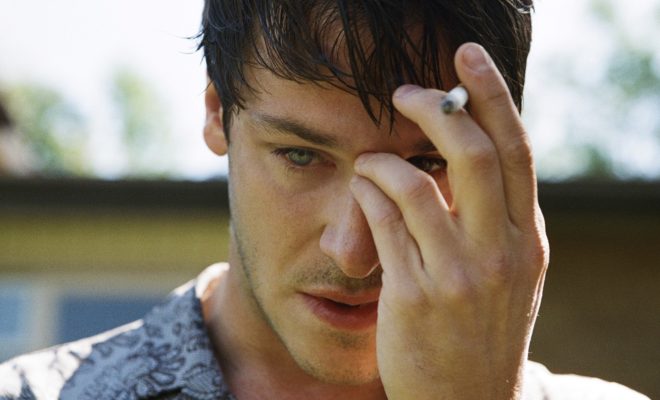
It is also impossible to over-emphasise the cast here, which probably consists of the biggest French-speaking acting talent active today: Marion Cotillard (Two Days, One Night (2014)) as Catherine, Lea Seydoux (The Lobster (2015)) as Suzanne, Nathalie Baye as Martine and Vincent Cassel as Antoine all perform well. The centre here, though, is Gaspard Ulliel as Louis. That character is the very definition of humility, and Ulliel plays the role so well the audience can immediately recognise and feel the character’s dilemma.
The climax of the film is effective: everyone, except maybe Louis’s mother, can finally guess (to some smaller or larger extent) the issue troubling Louis. In this context, intuition rather than knowledge is at play, but sometimes the former is more powerful than the latter. In the final scenes, the colour yellow suddenly emerges in the cinematography, probably finally acknowledging Louis as a “walking time-bomb”, waiting to go “red”. The friendly banter at the table suddenly turns into something animalistic as truth tries to emerge.
It takes some patience to follow It’s Only the End of the World to its finale, but the rewards are immense, especially on the emotional side. Playing nearly all its cards right, the story is trying to dissect a dysfunctional family, while touching movingly on such big themes as the importance of family and the fleetness of life (memento mori). Sometimes, it is an exercise of poetic contemplation, at other moments, it is a melodramatic catharsis. In the end, It’s Only the End of the World is an emotional, moving film which is as much about end-of-life reflections as it is about failures to communicate, and misunderstandings that sometimes ruin happiness, even if that happiness resides solely in the chance to say one’s final goodbye.
 Spotlight on Film
Whoa – sounds like you need the tissue handy for this one. Judging by your description, it sounds like a powerful and haunting movie, and I can’t wait to see it.
I was also impressed by the cast in this film, and am feeling a little sheepish that I hadn’t heard of it before. (And I call myself a Canadian. Sheesh!)
Thanks for joining the blogathon, and for bringing this film to the party!
LikeLiked by 1 person
You probably have not heard of this film because the reviews on it were not so good at all, and, thus, it did not get so much publicity, maybe. Still, I found the film amazing in a way it shows hidden emotion/fear/hesitation, etc. and a particular family dynamics. A very misunderstood piece of cinematography.
It was a pleasure being part of your great blogathon and thanks for having me!
LikeLiked by 1 person
This sounds difficult, yet worthwhile. I suppose we can’t have one without the other.
LikeLiked by 1 person
I think this film is very underrated. Reading some reviews, I am surprised I saw the same film as the rest of reviewers.
LikeLike
These were good choices, with Dolan on the rise outside of Canada, I haven’t seen this one but will check it out. Thanks so much for contributing so much to the blogathon!
LikeLiked by 1 person