
Luca [2021] – ★★1/2
Disney-Pixar’s Luca is an Italian Riviera-set animation that tells a story of a merman Luca and his family living underwater and having a hostile relationship with people living on land. Luca is a boy curious about the outside world, though, and soon becomes very interested in the “land” people. He meets a fellow merman, an “expert” in people, Alberto, and together they venture to discover “the unknown” or the “land” things, already having a goal in mind – to get their hands on an Italian scooter Vespa. The duo soon encounters a local bully, Ercole, and an eccentric tomboy, Giulia, as well as try to win a local race. Luca is gentle and sweet, who can deny this? It also has its share of laugh-out-loud sequences and beautiful images of a small picturesque village. Apart from that, the animation is painfully generic and even forgettable since its narrative is almost too insignificant, and if it were not for all the wonderful visuals and the Pixar/Disney name behind this cartoon, Luca would have qualified perfectly to be just yet another daytime television animation geared towards small children.
As can be seen from Frozen or Toy Story 4, when Pixar or Disney are not basing their animations on fairy-tales or doing their animation sequels, they are “narratively lost”, i.e. their animations have little narrative merit in terms of either imagination or original ideas. Sadly, Luca is yet another example of this recent trend. What do we have here? Of course, per Romeo & Juliet, Pocahontas, The Little Mermaid and countless other storylines, we have two worlds colliding, two worlds that have always been at war with each other. In Luca, this is the world of sea-people and the world of people living on land. Both bear time-long prejudices against each other and call each other “monsters”. In the world of Luca, the two worlds are also forbidden to interact with each other. What a boy Luca does, then? This is a narrative as old as time. Similar to Pocahontas and The Little Mermaid, of course, Luca makes the first proper contact with the other world because, of course, he is curious and not prejudiced at all. Similar to Coco, he breaks family rules and traditions and wants to prove his people wrong. He wants to experience the world of humans and he does…sort of.
Undoubtedly, the director of Luca is to be lauded for bringing something so personal and simple from Pixar/Disney to the big screen. Director Enrico Casarosa was born in Genoa and have wanted to make an animated story set in Italy for a long time, a story that will capture all the joys and wonders of his own childhood in Italy. As IMDb states, he also “based the film on his friendship with his childhood friend Alberto”. All this is rather nice, but “nice” is never enough anymore. The problem with Luca is that it watches like some clumsily put-together episodes of some daytime animated television series. Casarosa says he tried to make Luca in vein of Hayao Miyazaki’s films or was inspired by Miyazaki’s films, but, if this was his goal, Luca failed badly. It captures neither the subtlety of Miyazaki’s material nor its hidden depths as per Japanese tradition. Miyazaki’s animations are simple, yes, but they are full of quiet moments of inexplicable charm and their depth is often revealed through simple actions or the simple presentation of nature, through the slow unveiling of the true characters of its heroes. In turn, Casarosa’s Luca often feels like a hectic TV advertisement for an Italian resort. Its Italian stereotypes sometimes simply nauseate.
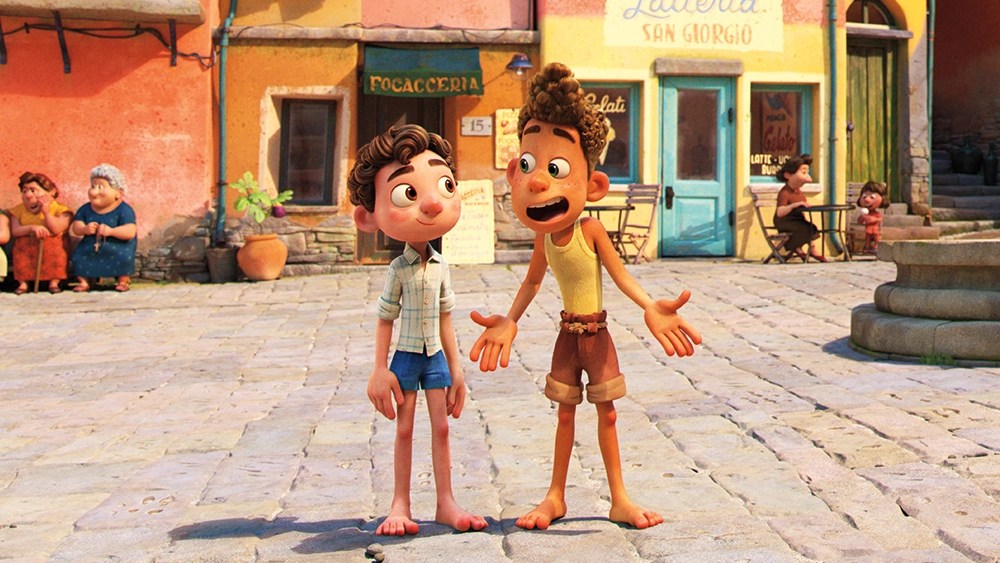
Generalisations about the Italian culture aside, as the central characters, Luca, Alberto, Giulia and Ercole clearly take the roles of Harry Potter, Ron Weasley, Hermione Granger and Draco Malfoy respectively and in that order. Luca, being a “special” boy who wants to discover another world, but his family prevents him, is similar to Harry from Rowling’s Harry Potter series who just wants to gain his freedom from his strict guardians and finds this freedom in another world. Luca/Harry and Alberto/Ron then meet one bookish tomboy Guilia/Hermione and fight a local bully who terrifies everyone – Malfoy/Ercole (like Harry Potter and the Philosopher’s Stone, Luca even ends with a trip on a train).
To make matters worse, Luca does not have a discernible plot-line at all, but has many plot holes and illogicalities. In the story, mermen Luca and Alberto finally find their way into the Italian village of Portorosso, and what do they immediately do? They inexplicably want to compete in a local race that involves swimming, cycling and eating pasta. Really? But, what is even more amazing – that’s the whole plot. Then, the questions should arise – why would these mermen have the ability to transform into humans? How that process happens and why? Why mermen and mermaids never previously ventured on earth and their achievements in this respect never recorded? Humour helps a lot in Luca, and the animation is very funny at times. Besides, it has its wonderful music and amazing dream sequences. However, the score does fit the story rather awkwardly at times and its theme of prejudice-fighting, as per Shrek, never sadly materialises into anything significant.
Luca’s sweetness and gentleness are evident, and its good intentions abound, but the verdict is that its “local flavour” and spectacular visions hardly save it, and Luca has probably redefined the whole meaning of a phrase “hardly ground-breaking”.
 Spotlight on Film
This is proving a polarising film – it is either “meh” or a 5 star modern classic… <_<
LikeLiked by 2 people
Oh, if some consider it a 5 star modern classic then the standards have fallen the lowest they have ever been. I almost regret I wasted my time watching it.
LikeLiked by 2 people
Well, everyone is entitled to their opinion… 😉
LikeLiked by 2 people
I haven’t seen Luca, but I heard the movie was pretty mid as the people on the internet say. That is weird how there would be Italian stereotypes especially if the director was from Genoa. I’m not sure how I feel about that. The Miyazaki influence claim does sound shallow as you say if he didn’t know how Miyazaki’s stuff works.
LikeLiked by 1 person
Yes, I guess the director realised he still needed to “sell” Italian culture to the American audience, or something. I wish I loved this film more, but even looking at it now when time passed, it still feels forgettable and I don’t think I would want to watch again, something that I cannot say for example for Soul or Inside Out or Coco.
LikeLiked by 1 person
Gotcha. That is strange, and I wish he could’ve handled it better. It’s a bummer how it’s more forgettable. I haven’t seen the newer Pixar movies. I’ve heard good things about Coco, but I wasn’t a fan of Disney trying (but thankfully failing) to trademark the name “Dia de los Muertos/Day of the Dead”, but thankfully they had enough backlash against their attempt of cultural appropriation for them not to “own” that holiday which is huge in Mexican culture. I’ve had the fortune to be a part of an event at a job I recently resigned where I celebrated with Mexican immigrants on that day and I learned more about the holiday and traditions.
LikeLiked by 1 person