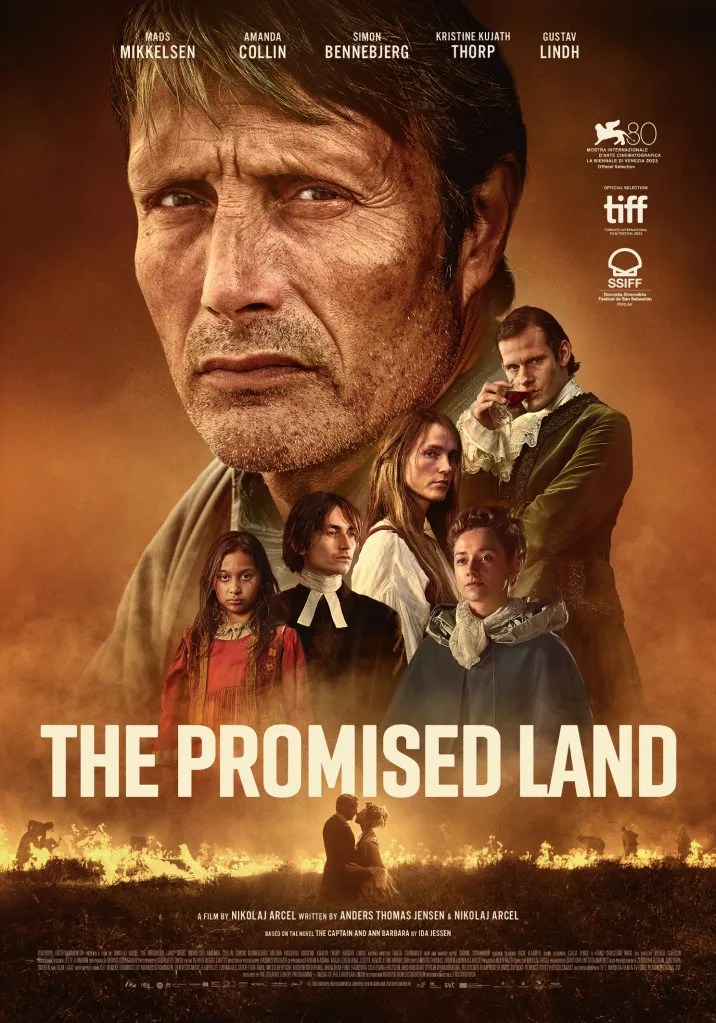
The Promised Land [2023] – ★★★★1/2
In 2012, Nikolaj Arcel took the cinematic world by storm with his Mads Mikkelsen-starred period drama A Royal Affair that vividly re-created one turbulent chapter in Danish history, as it propelled forward the then rising talents Alicia Vikander and Mikkel Følsgaard, who, remarkably, held their own vis-à-vis the Danish superstar. Now, more than ten years later, the director is back with another Danish history drama, but, this time, led solely by Mikkelsen and adapting Ida Jessen’s novel The Captain and Ann Barbara (2021). This fiction re-imagines the visionary work of real historical figure Ludvig von Kahlen (Mikkelsen), a Danish Captain who once made a deal with the King to set up a colony in one rugged, deserted region of Jutland in the eighteenth century.
Mikkelsen’s previous roles of a survivor in harsh conditions in such dramas as Valhalla Rising (2009) and Arctic (2018) must have come in handy in The Promised Land, where the actor is now an aging war veteran (Von Kahlen) with a singular purpose to establish a settlement in the middle of nowhere, on moors of the Danish kingdom, a place which no one believes could ever bring any profit. Von Kahlen, a man of steely determination, is not dissuaded by the challenges to come: barren land, lack of any amenities or dangerous vagabonds. He wants a title and an estate if he manages to succeed in his mad endeavour, and the Danish Royal Treasury slyly agrees to his terms. And, for all we know, Von Kahlen can succeed, because, as Vigil once put it – “they can do all because they think they can”.
Arcel thrusts his hero from the splendours of the royal court into a “state of nature”. Von Kahlen lands in one harsh, violent world. It echoes a peculiar Scandinavian bleakness, especially that surrounding farming attempts in such novels as Hamsun’s Growth of the Soil or Moberg’s The Emigrants, and the film itself emits western undertones of brutality and despondency reminiscent of the work of Arcel’s compatriot Kristian Levring (The Salvation) or Dutch Martin Koolhoven (Brimstone). As in A Royal Affair, Rasmus Videbæk’s haunting camera-work captures the primordial beauty of the region with the artistry of a master painter, from vast expanses of misty moors at dusk to sunlit barren pastures longing for a flower. And, the director hardly wastes an opportunity in drawing contrasts between Von Kahlen’s humble abode on the moors and the opulence of the Danish royal court or the life of extravagance and luxury that cruel local landlord Frederik Schinkel (Simon Bennebjerg) enjoys on his estate.
It soon turns out that Von Kahlen’s environmental challenges are nothing in comparison to Schinkel’s devilish machinations to get Captain off the King’s land or submit him to Schinkel’s own dominion. Arcel keeps the action moving with many scenes of this “battle of wills” between the two contrasting men, one with inner integrity, dignity and a sense of justice, portrayed effortlessly by all-too-reserved-in-his-role Mikkelsen, and another with narcissistic, psychopathic and progressively sadistic tendencies, not unlike those displayed by a slave-master in McQueen’s savage indictment on slavery – 12 Years A Slave.
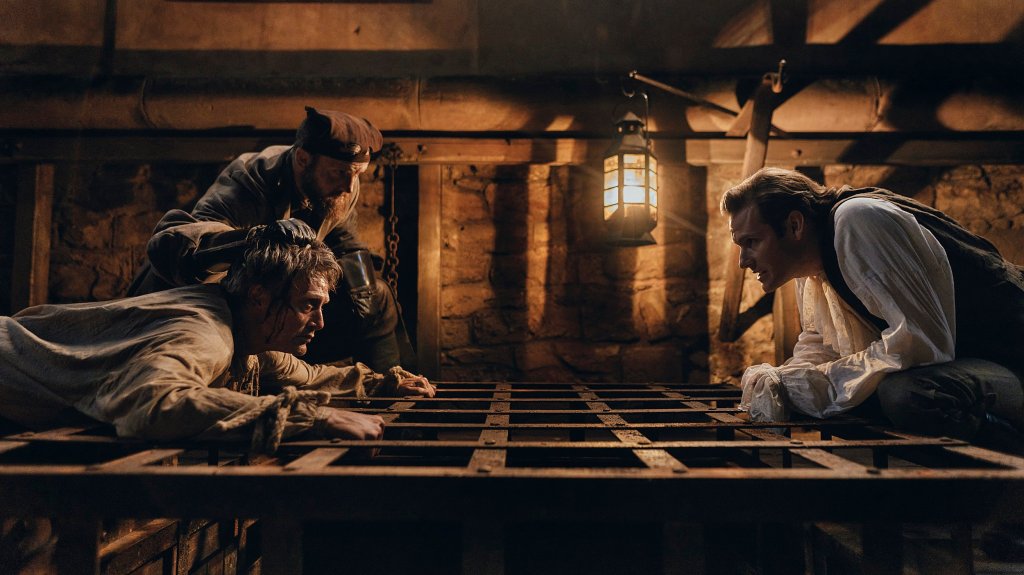
And, there are slaves or, rather, runaway indentured serfs to rescue from the abuse committed by their master Schinkel. Johannes Eriksen (Morten Hee Andersen) and Ann Barbara (Amanda Collin) are a husband-and-wife pair who sought refuge at Von Kahlen’s King’s House after fleeing Schinkel. Their lucky escape would come to haunt them, but other outcasts soon also attach themselves to our zealous pioneer, including a little gypsy girl named Anmai Mus (Melina Hagberg) and sympathetic young priest Anton Eklund (Gustav Lindh). Clearly, Von Kahlen’s allies are few and far between, but Schinkel’s cousin Edel Helene (Kristine Kujath Thorp) is also one of them – a beautiful woman who is now counting on Von Kahlen to rescue her from a forced marriage to progressively-out-of-control Schinkel. Since it is a novel adaptation, it is perhaps unsurprising that the story develops with a character-focus that is almost literary in nature, while not forgetting to shed light on Ludvig von Kahlen’s own evident faults – his stubbornness and refusal to admit defeat do lead to trouble and put people in grave danger. Besides, one never wins any battles by resorting to the same evil methods as their nemesis.
The film is acutely aware of its period when rigid class system dictated people’s lives. Von Kahlen, whose mother was a cook and father – a lord, is grappling with his identity and is under pressure to prove that he is deserving of societal recognition by way of a noble title. It had already taken him some 25 years to get from the position of a gardener to that of a captain (a man of nobility can do it in six months), and his standoff with Schinkel is also framed as a class conflict. This story of class boundaries being infringed, and what happens if one dares to rise above one’s birth standing get even more thought-provoking when Von Kahlen hires local gypsy people as workers on his land. These people are found at the very bottom of the societal ladder, representing a bad omen for a community and experiencing much prejudice.
Schinkel wants Von Kahlen to accept that life is arbitrary and chaotic, but Captain’s position is that anyone can restore order, subdue nature and rise to the top through hard-work and intellect. In essence, this is A Royal Affair in reverse. It is no longer the enlightened bourgeoisie who insist on the ideas of Reason to be brought to the people, but, in the spirit of Robin Hood, the outcasts unite to show reason to, and against, the elite’s prejudice and arbitrary tyranny. Such simple, but intelligent and hard-working, men like Von Kahlen pose a threat to the whole established order. The Promised Land’s ending makes it clear that the drama’s essence lies in Von Kahlen’s idealistic view of society and his King being dashed and burned.
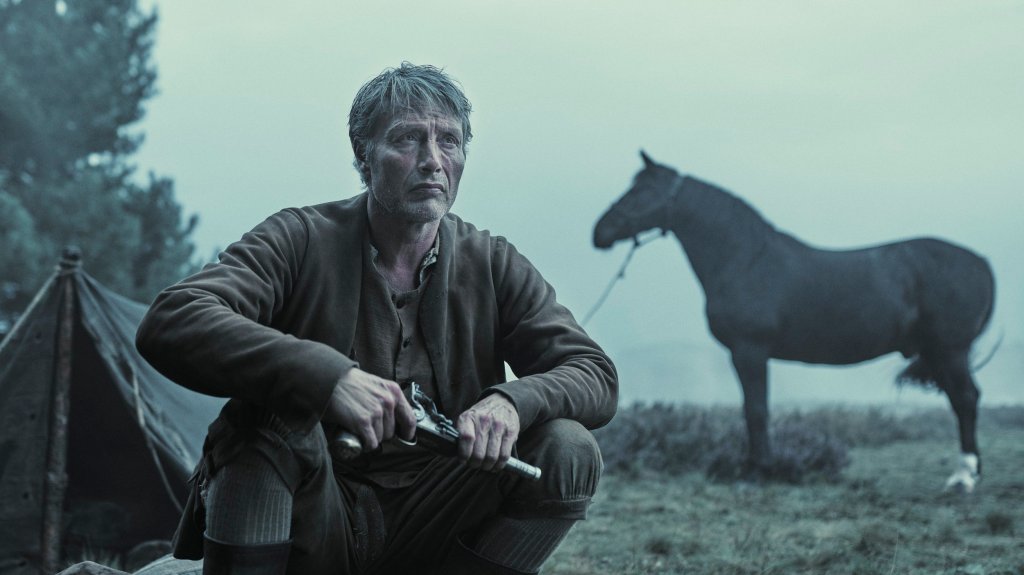
In the end, the film’s touch of sentimentality comes at a cost because the narrative never lifts a finger to explain at what point Von Kahlen and Ann Barbara’s relationships develops into loving (from being purely physical) or how we are supposed to believe in older Anmai Mus’s or Edel Helene’s love at first sight (the latter is inexplicably dropped as a love-interest, too). Moreover, even if the English substitution of Dutch film title Bastarden (The Bastard) does restore some dignity to our main character, it also robs the film of its heroic biopic reference. The land is more “lost” than “promised” here, and it also turns out that the story’s core is not the land, but the hearts of people – what they do, do not do, and must do for others.
“Ah, but a man’s reach should exceed his grasp/Or what’s a heaven for?, famously declared Robert Browning. By the end of The Promised Land, we and Ludvig von Kahlen are no longer so sure of that. “Things rarely turn out the way we imagined they would”, is the final message of the film, but it may as well be the quote from T.S. Eliot: “And the end of all our exploring/Will be to arrive where we started/And know the place for the first time.” A journey shapes you, moulding you, perhaps already battered and bruised, into someone who may no longer see the point of your destination, a place you cherished so much just before your journey.
Nikolaj Arcel is a sure historical drama torchbearer, whose flame we cannot afford to see extinguished if we care about quality historical drama and its future. Utilising almost all the elements that made A Royal Affair such an engrossing historical spectacle a decade prior, The Promised Land sees Arcel’s glorious return to form and to the familiar genre after his detour by way of lukewarmly received science-fantasy The Dark Tower. In The Promised Land, there is the same resolute performance by Mikkelsen and Videbæk’s evocative cinematography, but also a renewed sense of urgency to spearhead traditional story-telling, that kind of a narrative that, like this year’s Costner’s Horizon, transports one instantly to a bygone era and to the magic of old movies that make you crave an exciting shoot-’em-up adventure. For all its lapses in portraying romance, The Promised Land is still an inspiring, relentlessly gritty tale of one undying determination, an indomitable will to achieve the impossible against all odds.
 Spotlight on Film
It’s been a while since I watched Scandinavian movies and I’m obviously not counting the 1996 version of Hamlet even if it takes place in Denmark. Movies involving classism can be hit or miss for me (I feel like the ones in Hollywood lean towards the latter in my opinion). I’m also curious how they portray a Romani character in this film because you still have people who think everyone is like Esmeralda from Hunchback of Notre Dame.
LikeLiked by 1 person
One more or less prominent Romani character is a little girl, I thought rather adorable with a distinct personality. The others were not the main focus as such. The last Scandinavian film I watched was also a while ago – Godland about a Danish priest, and also historical. Danish films and literature continue to surprise, though now I think Godland’s director is from Iceland.
LikeLiked by 1 person
Gotcha. I was just wondering when it came to those characters. You and another British blogger I follow reviewed this movie days within each other which is interesting timing. Apparently they played this movie on UK TV.
I think I saw that review of Godland a while ago. Denmark does have interesting movies. The first Western animated movie I reviewed was from a Danish director and it’s called Strings which is my favorite puppet/marionette film that has a very unique twist on the usurping dysfunctional family plot point where the original king actually commits suicide while his wicked brother frames it like a suicide before taking over the kingdom. That’s not a spoiler because it happens very early.
LikeLiked by 1 person
**frames it like a murder. Sorry about the error.
LikeLiked by 1 person
I will definitely try to check it out, Strings sounds something I would enjoy, thanks!
LikeLiked by 1 person
I think you’ll enjoy it and it’s a very creative work. It’s also fascinating how the characters know they are marionettes and their strings play a role in existence and world-building.
LikeLiked by 1 person