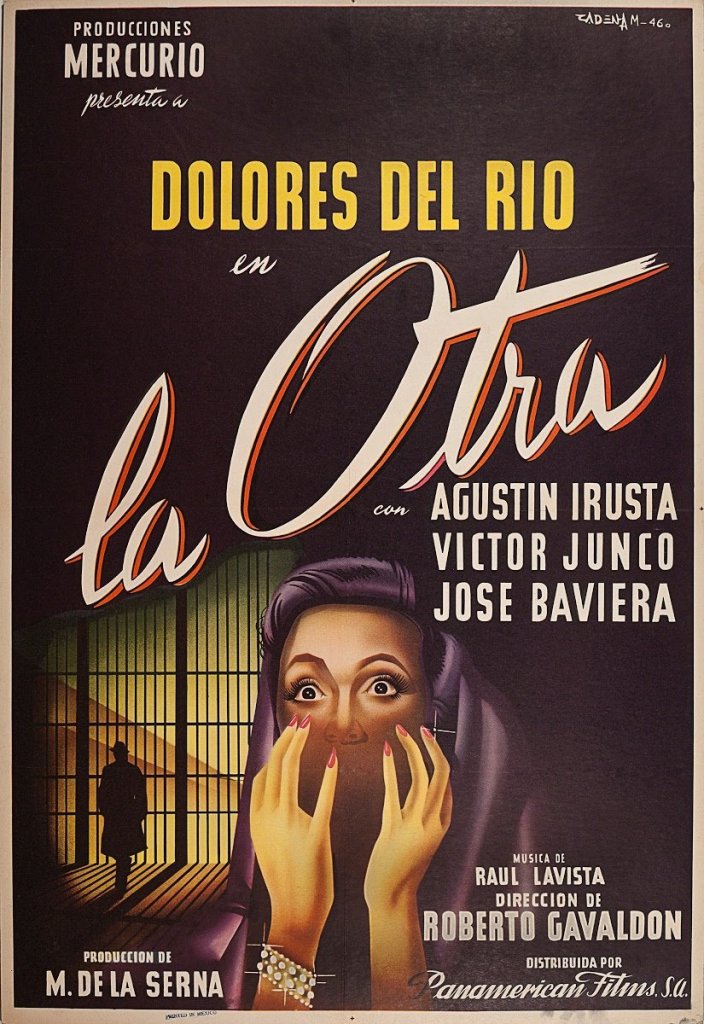
La Otra (The Other) [1946] – ★★★★
This is a film that (at least for the English-speaking audience) is probably better known as the one that was later adapted by Hollywood as Dead Ringer (1964) starring Bette Davis in the dual role. Roberto Gavaldón (Macario (1960)), one of the most celebrated Mexican directors, is at the helm of this production that focuses on two sisters: successful and rich socialite Magdalena (Dolores del Río) and her identical twin María (Dolores del Río), a poor manicurist barely scrapping a living. When Magdalena’s millionaire husband dies living her the inheritance of some 5 million dollars, María is tempted to take her sister’s place, passing as the rich widow. But, of course, the two women are very different in their personalities (one is confident, and another – shy), even though they are strikingly similar in looks (in one of the key scenes, Magdalena’s steward mistakes María for his mistress when she puts a luxurious shawl over her head to look in a mirror). Let’s suppose that María will do something that enables her to take her sister’s place, how would she sustain the deceit and for how long?
With such a thrillingly psychological story and character idea as identical twin sisters, one of whom is caught up in the secret life of another by wanting to imitate it, this is a film script that almost wrote itself, and a film that was capable of shooting itself. This is a tale of one pair of twin sisters’ rivalry and jealousy, emphasizing their uncanny similarities in look, so one hardly needed to work hard to maintain our interest or suspense in this film. And, indeed, the concept is so intriguing that, in the same year of 1946, Hollywood produced not one, but two films with a similar concept – Curtis Bernhardt’s A Stolen Life, and Robert Siodmak’s The Dark Mirror. Both of these films focus on a curious relationship between two identical twin sisters, one of whom uses their physical similarities to gain some advantage.
The difference here, in La Otra, is that it is more thought-provoking in the sense that we do not really have such a black-and-white demarcation between the “good” sister and the “evil” sister. We first begin by sympathising with poor and downtrodden María, who cannot rise above her pitiful circumstances, and even has to stop the romantic advances of her optimistic law enforcement man Roberto (Agustín Irusta) because she does not want to drag them both to poverty. And, we look down on her arrogant, vane sister Magdalena, who even suggests to her sister María that she should do sexual favours to clients to earn more money. It is not long, though, before tables turn since “desperate times call for desperate measures”, as the saying goes.
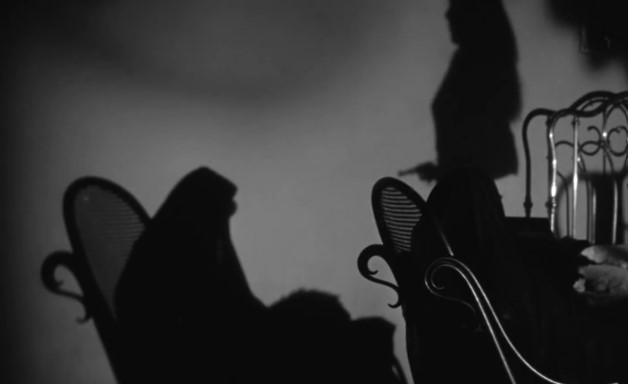

The great Dolores del Río impresses in the tricky dual role, playing two completely different people. It is thanks to this actress’s wide emotional range and nuanced embodiment of distinct personalities that we can suspend our disbelief that people who knew either of these two women before could not immediately recognise that this was a case of an imposter. For the most part, the film proceeds rather predictably, but some scenes of immense intensity still carry a lot of muscle and punch, elevating this Spanish-language film, making it rather Hitchcockian. For example, when María commits her crime, when she is surrounded by her guests in Magdalena’s home for the first time, and when she is forced to identify her sister in a morgue, and then sign the deed documents.
The brazen score fuels the film’s drama further, but there is hardly any need for any further dramatization. Magdalena’s love life resurfaces, something on which María did not count and does not know how to handle, especially when that love life emerges with dark secrets to boot. The film recycles the ancient, done-to-death theme that “crime never pays”, and, after such films as Dead Ringers, The Talented Mr. Ripley, Catch Me If You Can, and Parasite, the modern audience may no longer find the imposter scenario as awe-inspiring as they did in the 1940s. However, there is ample compensation. If you ignore the film’s bewildering denouement, and focus on the unusual identical twins’ situation, Dolores del Río’s strong lead, and atmospheric film noir aesthetics, you realise you have a true cinematic gem on your hands.
 Spotlight on Film