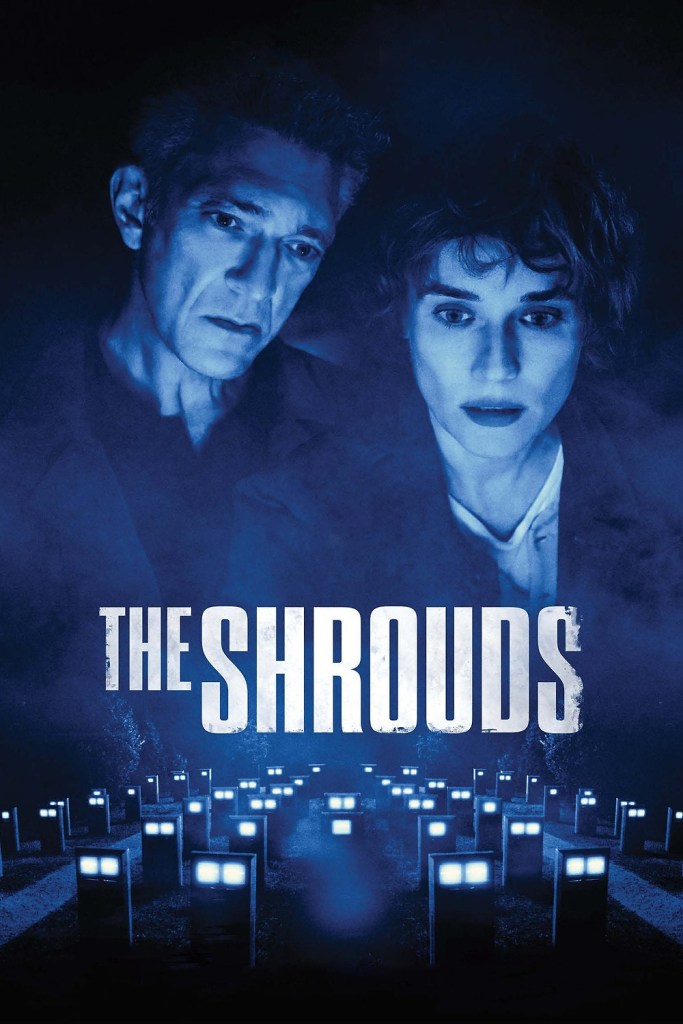
The Shrouds [2024] – ★★★
How far are we prepared to go to remain close to our loved ones after their death? Cronenberg proposes an intriguing concept in his film The Shrouds by introducing us to businessman Karsh (Vincent Cassel) and his invention – a cemetery equipped with “ShroudCam”. This enables those grieving to view their family members’ decomposing bodies buried deep underground in a new way. Karsh knows something about grief and how obsessive people can get over those that passed away because he lost his own wife, Rebecca (Diane Kruger), to cancer, and has troubles dealing with her death. This is especially so when he finds out that she may have been either a willing or unwilling subject of dodgy medical experiments on the part of her oncologist Dr. Jerry Eckler (Steve Switzman). But, that is also far from Karsh’s main problem, as on top of that, he has to find the culprits of the vandalism that has recently been inflicted on his cemetery by an unknown group, make sense of an international conspiracy brewing somewhere far or near, who knows, guess the causes of the strange behaviour of his online assistant Honey, and wrap his head around his conflicting feelings for Rebecca’s remaining twin sister Terry (Diane Kruger).
When a film is just “all over the place” you know that the director’s original script was also a mess. The Shrouds is like that. It constantly pulls the viewer in different directions, not hitting any cinematic themes or notes with focus or confidence, save maybe for one – Karsh’s troubled state of mind (over-emphasised). Karsh is either led into some weird theory rabbit hole by his brother-in-law Maury (Guy Pearce), muses on his loneliness (while experiencing sex “differently” with his new “girlfriend” Soo-Min (Sandrine Holt)) or has strange dreams involving his ex-wife that are somehow known not only to him. Is there a conspiracy to bring his company down on the part of some international parties?, the story asks. And, was Rebecca, before her death, involved in dangerous experiments that may explain certain tiny objects that are now found on her decomposed body? Cronenberg did not think to pull us into any of these questions on the emotional level at the start of the film, so we will not care. The stakes were simply not raised.
The main concept is also “shaky”, to say the least – for starters, it is hardly realistic that anyone would want to come face-to-face with one beloved’s decomposing or skeletal remains “to ease” any grieving pain, but it is Cronenberg, so yes, there is this intriguing idea, as well as plenty of “sumptuous” examples of bodily horror, together with interesting psychosexual and techno-futuristic overtones of such films as Crash (1996)and Cosmopolis. However, the film’s thought-provoking theme of how we, as humans, deal with death and grieving, and how we may do so in future (would we objectify/”commercialise” the deceased?) sadly also get swallowed up by Cronenberg’s competing narrative threads that, at one point, have to do with Chinese or Russian conspiracy to bring down Karsh and his company…or maybe not? Who knows. And, in those moments where we are taken along for some complex conspiracy or techno-medical talk trip, The Shrouds even appears Nolanish, but without action sequences to compensate for our confusion, and, at other times – Lanthimosian, but without the skill of Lanthimos in the satirical, “dead-pan” department.
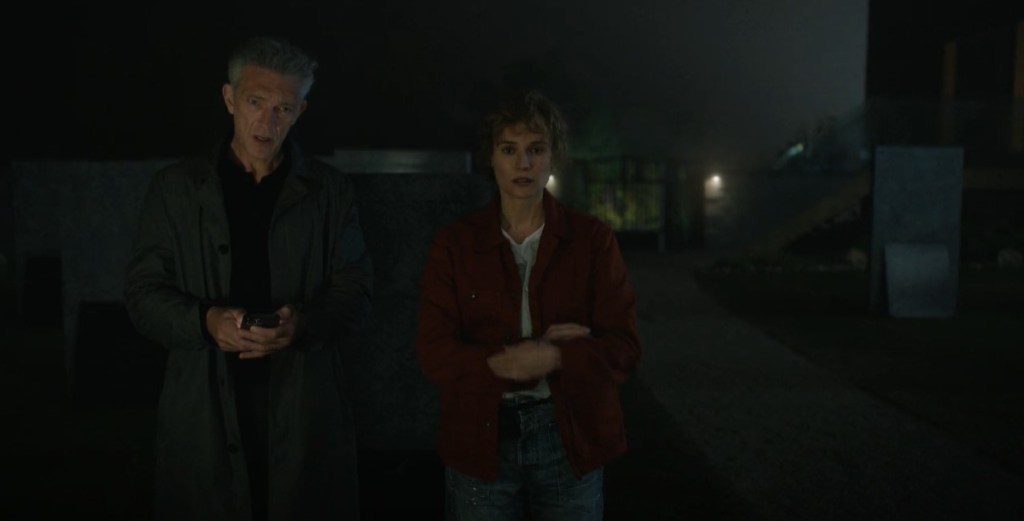
Vincent Cassel plays Vincent Cassel, an obsessive, charismatic man, but we never really connect with him because he also comes off as arrogant and distant. It does not help that the actor’s delivery is at times on the unbelievable side, with some scenes just reeking of artificiality. “Are you having sex with her (Soo-Min)?”, asks Terry of Karsh, alluding to him being spotted arm-in-arm with Soo-Min. Terry asks this question in the way that should make us believe that this is, indeed, the most important question of the entire story. As the audience, we would not care either way. And, because we won’t, it is scenes such as this one that your average viewer would deem “dull”. One first arouses a clear interest (a thing Cronenberg never does), and then poses a question. The film gets corny early on.
So, The Shrouds is a stylishly-executed film that pulls you in just on the basis of its intriguing, macabre concept of “the shrouds”, an invention that raises all sorts of moral and philosophical questions. Cassel also commands enough attention as a lead for us to want to know what happens next in the story. The problem, of course, is that we would hardly care when we find out. The film’s twists largely fall flat, the conspiracy theories and other important revelations are introduced in such a contrived manner as to be almost laughable, and, at times, the forced dialogue delivery just raises eyebrows. It is hard to take this film seriously after all that. If there is any director today who deserves to make any film and in whatever way they want without undue criticism, it is David Cronenberg, but his self-indulgent, increasingly unfocused approach in The Shrouds still simply exasperates.
 Spotlight on Film
I knew Cronenberg was working on a movie but no more than that. Vincent Cassel and Diane Kruger are big draws. The plot sounds intriguing. Even with flaws, his worst beats the best of many others. I will see it if I get a chance.
LikeLiked by 1 person
It is worth watching for the look of it, I guess. The ideas are always there, but I do believe that when Cronenberg is alone at the helm of scriptwriting, a film’s storyline suffers (not least from dullness). Even his arguably best script, Videodrome, suffers narratively.
LikeLiked by 2 people
You look upon him less favorably than I do. Have you seen Crimes of the Future?
LikeLiked by 1 person
Me? I am a BIG fan of his. Some of my all time favourite films include Dead Ringers and A History of Violence. I just have to call a spade a spade when reviewing, and my love for his previous work does not cloud my judgement of his present one. I have seen Crimes of the Future, and I prefer his earlier work. It pains me to see how directionless, confused and unfocused the cinema of today has become.
LikeLiked by 2 people
A History of Violence is a good choice and it’s weirdly enough Cronenberg’s most “normal” movie I’ve seen of his.
LikeLiked by 1 person
This is so true, isn’t it? 🙂 Yes, I guess I do gravitate towards more palatable of his films. Spider (2002) was also very good.
LikeLiked by 1 person
Glad I’m not the only one who noticed that about his filmography. I’ll have to check out Spider, too.
LikeLiked by 1 person