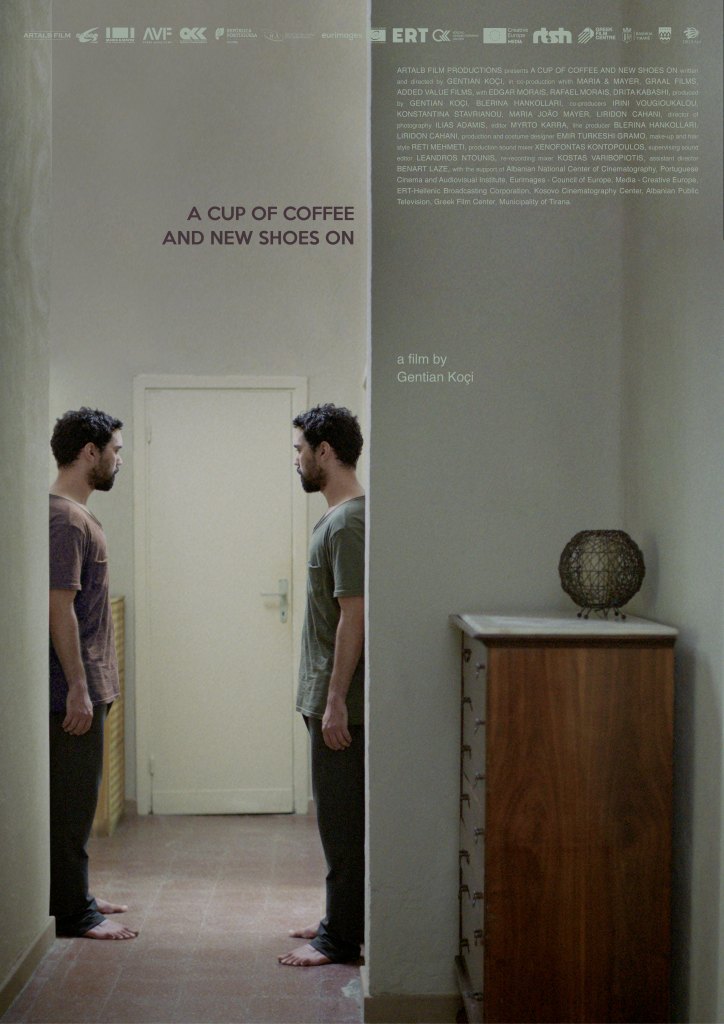
A Cup of Coffee and New Shoes On [2022] – ★★★1/2
<<<The following review contains a plot spoiler>>>
Films about twins usually either play with these twins’ contradictory natures to scary effects (The Dark Mirror, Dead Ringers) or construct plots of comedic turns that emphasise the consequences of these twins’ outward similarities (Big Business, The Parent Trap). Gentian Koçi’s stylishly-executed A Cup of Coffee and New Shoes On is about twins, but, refreshingly, it incorporates none of those familiar tropes. Instead, drawing on touching instances of brotherly affection and emotional support, the film unites the duo of deaf-mute identical brothers in the face of the horrific and the inevitable: the prospect of losing sight forever.
We first meet twin brothers Agim and Gëzim (Rafael and Edgar Morais) in their tidy, light green-coloured apartment in Tirana, Albania. The brothers seem inseparable and do most things together: working in a construction company, meeting friends for a beer or two, and occasionally going to a cabin in the countryside where they spent time hunting and foraging. It is an idyllic life of calm and peace, whose other essential component is Gëzim’s girlfriend Ana (Drita Kabashi), a person who is always around and willing to inject bursts of joie de vivre into the brothers’ introverted and plodding existence.
Koçi’s elegantly framed sequences soon unveil the first dramatic point in the story: Agim momentarily loses his vision while driving. After that, the twins waste no time scheduling an appointment with a doctor to check their health, and, while they await their medical test results, we get to know more of their deep brotherly bond, inter-connectedness and inter-dependence. Portuguese actors Rafael and Edgar Morais actually learnt the Albanian Sign Language for this film, and their delicate, thoughtful performances heighten the film’s slow-burn drama. In one scene, Agim simply watches Gëzim dancing with Ana. However, his haunting stare pains, as the actor manages to say a hundred ineffable things just with his eyes alone. It turns out that the twins have inherited a rare genetic disorder that would eventually turn them both completely blind.
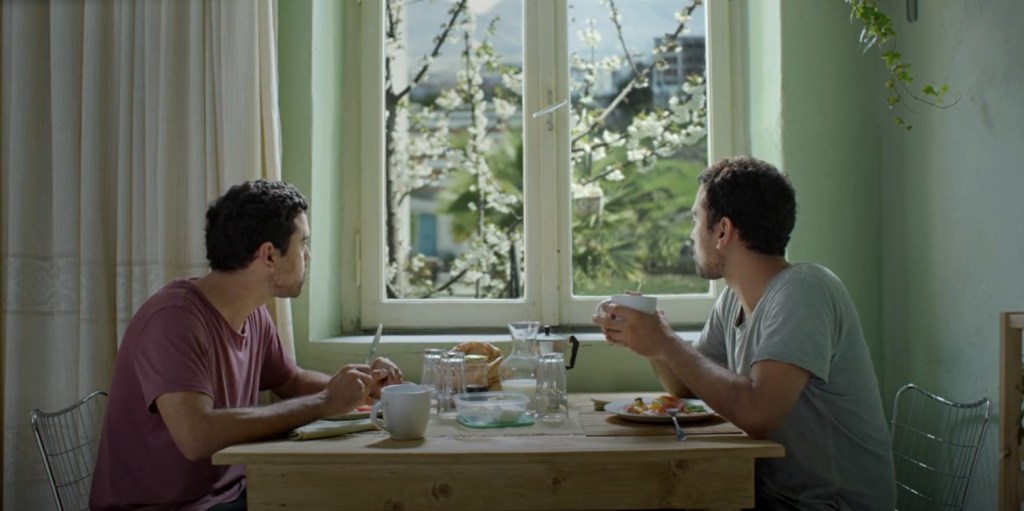
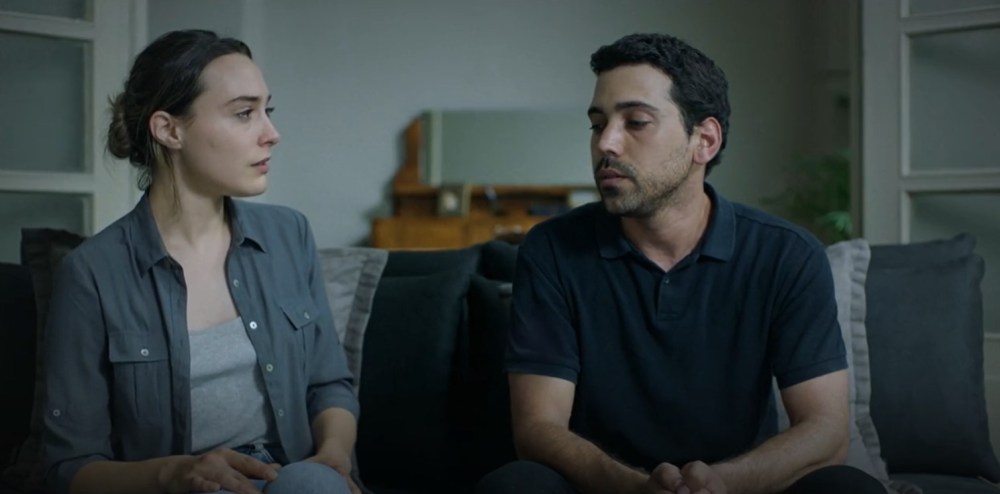
Director Koçi, who is also the scriptwriter, puts his main characters through the usual cycle of grief as they try to come to terms with their horrifying predicament, but though there are occasional angry outbursts on the twins’ part (Gëzim initially hides their double diagnosis from his brother), it is the mellow, languid displays of melancholy that are the most heart-breakingly memorable. The twins’ brooding silences run in parallel to the slow realisation of hopelessness and helplessness. In one scene, Agim closes his eyes and tries to do his mourning routine blindly, including brushing his teeth and going to the toilet. Gëzim listens quietly to his twin’s efforts through the door. Then, the sight of poorly washed dishes signals the final defeat. And, it is probably in this that the film’s true merit resides – in the subdued presentation of bitter, frightening things to come. It is not even the impending loss of their visible world that the brothers start to grieve, but the fact that, in future, they will no longer be able to do that which has always been at the very core of their life, giving it its ultimate meaning – to support and look after each other.
Ilias Adamis’s cinematography goes for muted palettes that underscore the brothers’ calm existence prior to the diagnosis. Their routine spirals out of control after hearing the results of Agim’s eye examination, but the film’s measured pace never falters, and, amidst the plot’s disturbing, bleak contours, we still feel immense warmth from the brothers’ union. The film exudes almost Bressonian “silence”, eschewing major spectacles in favour of visual sterility. However, despite Koçi’s attempts to inject many moments of still poignancy, there are numerous shots that are cut abruptly just as this or that scene gets to the most fascinating point, draining the narrative of much curious development. This, together with the possibility that the stakes have not been raised high enough at the story’s start, means that A Cup of Coffee and New Shoes On does not quite reach its full potential in establishing a tragic sense of conviction.

There is also a strange dichotomy between the film’s straightforward, minimalist story and the ever-growing-in-complexity unique situation within this narrative, and it is not always easy to differentiate Agim from Gëzim in any individual scene. But, maybe that is the point? The idea that we should see them as one inseparable unit? The cinematic lens hardly ever encountered a twinship bond closer or more palpable than that shared between Agim and Gëzim. They were first united by their twinship, then muteness and then their diagnosis. And, there is something about the look that the brothers give each other throughout this film that seems to go over and beyond any attempts at our understanding, unless some of us also know first-hand what it is like to be part of a completely indivisible twin unity.
The film’s controversial ending is the culmination of the twins’ mental struggle, but, through its visual symbols, it also resembles an elegiac epilogue. There is a cup of coffee and new shoes in the film’s final images, with “coffee” probably standing for the fleetness of the bursts of energy contained within a cup, and “new shoes” symbolising not the end of the journey, but possibly its beginning in some new form. Ana, that constant, kind, empathetic mediator between the brothers’ inner circle and the outside world is now kneeling in front of them near a table. She would now be a link between life and death, but the final result of her intermediary efforts still remains somewhat uncertain.
Elegantly presented with sensitive performances, A Cup of Coffee and New Shoes On is an introspective study of copying with one frightening medical diagnosis that also taps into the unfathomability of a twinship bond.
 Spotlight on Film
This looks like a fascinating movie with a unique subject with twins. Thanks for sharing!
LikeLiked by 1 person
Thanks for reading! That’s what drew me to the story – its absolute uniqueness.
LikeLiked by 1 person
No problem! Uniqueness is something that is lost in so many films these days.
LikeLiked by 1 person
Hi! Do you review independent short films?
LikeLike
unfortunately not, very sorry about this.
LikeLike